

Florida practitioner guide
Florida ESI Preservation and Discovery for Litigation Counsel
Florida's civil rules now track the federal approach to electronically stored information: early disclosure of ESI sources, proportional discovery, production in usable form and a sanctions rule for lost ESI that turns on reasonable steps. This guide turns each rule into the preservation record that proves you took them.
Updated November 3, 2026
(786) 219-121024/7: (800) 868-8189
Electronically stored information is discoverable in Florida under Rule 1.280(c)(3), and the October 1, 2026 edition of the Florida Rules of Civil Procedure treats it at every stage: initial disclosures, the scope of discovery, the form of production, subpoenas and sanctions for loss. A party that can show its preservation steps source by source is in a strong position on every one of those rules.
GDF examiners preserve, collect and produce ESI for Florida counsel and companies, and we document each step so the record explains itself months later, when a custodian has left or a retention policy has run.
1. Discovery Scope Is Relevance Plus Proportionality
Rule 1.280(c)(1) permits discovery of any nonprivileged matter relevant to a party's claim or defense and proportional to the needs of the case, weighing the importance of the issues, the amount in controversy, the parties' relative access to information, their resources, the importance of the discovery and whether its burden or expense outweighs its likely benefit. Rule 1.280(c)(3) states expressly that a party may obtain discovery of electronically stored information under the rules. [1]
Proportionality arguments are won with facts about the systems. Knowing how many custodians, mailboxes, devices and collaboration spaces hold relevant data, and what it costs to collect and review each source, lets counsel propose a scope the court will accept and resist one that is out of proportion.
2. Initial Disclosures Put Your Source Map on a Clock
Unless a case is exempt under Rule 1.200(a) or the court orders otherwise, Rule 1.280(a) requires each party, without awaiting a request, to provide a copy or a description by category and location of the documents, electronically stored information and tangible things it may use to support its claims or defenses. The disclosures are due within 60 days after service of the complaint or joinder unless the court sets a different time, they rest on the information then reasonably available, and Rule 1.280(g) requires timely supplementation when a disclosure turns out to be incomplete or incorrect. [1]
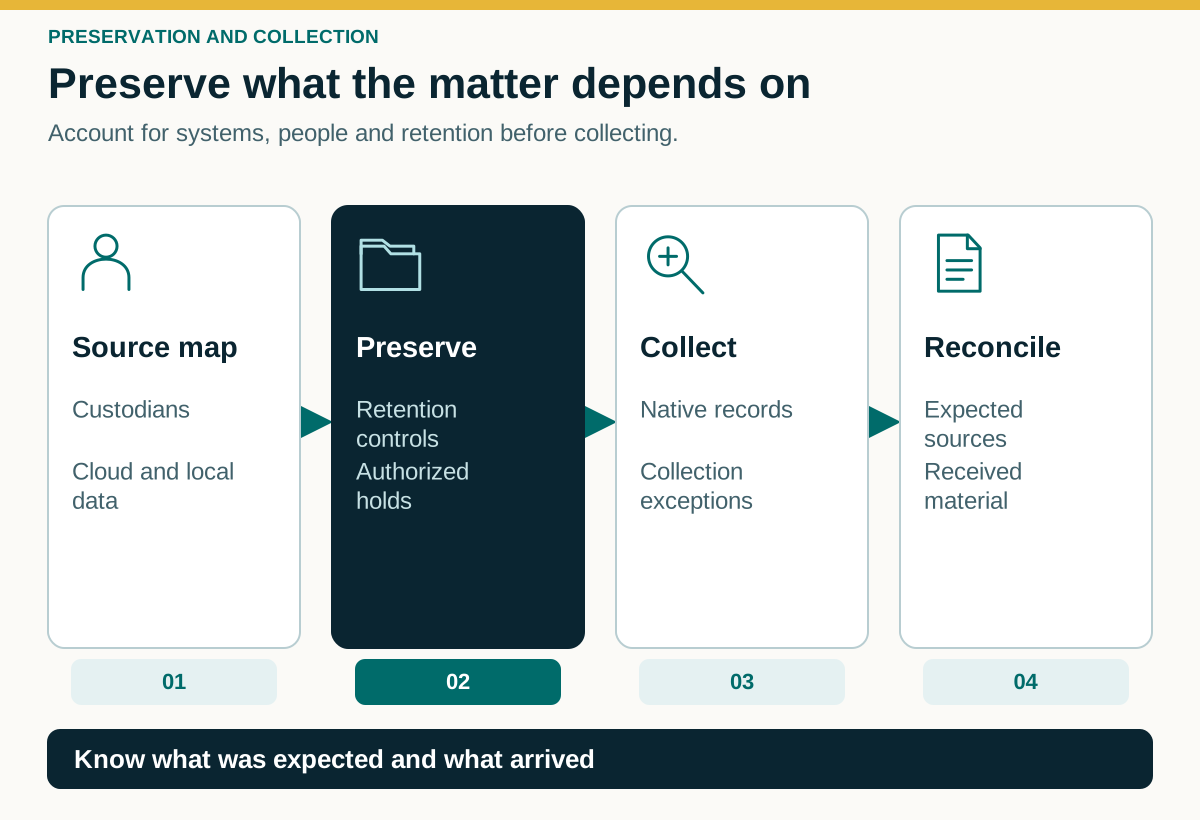
A description by category and location is only as good as the data map behind it. We build that map in the first weeks: each custodian's accounts, devices, shared drives, chat platforms and business systems, who administers them, and what retention settings apply. The same map drives the hold notices and the collection plan.
3. Rule 1.380(f) Draws the Sanctions Line for Lost ESI
Rule 1.380(f) applies when electronically stored information that should have been preserved in the anticipation or conduct of litigation is lost because a party failed to take reasonable steps to preserve it and cannot be restored or replaced through additional discovery. On a finding of prejudice, the court may order measures no greater than necessary to cure the prejudice. Only on a finding that the party acted with intent to deprive another party of the information's use may the court presume the information was unfavorable, instruct the jury that it may or must presume so, or dismiss the action or enter a default judgment. [1]
Every element of that rule is a factual question an examiner can document. Reasonable steps are shown by dated hold notices, acknowledgments, retention changes and verified preservation. Restoration or replacement is shown by backups, other custodians' copies, provider records and recovered data. Intent is argued from the timeline of who changed what and when. We keep those records in one register so counsel can answer a motion with evidence, not recollection.
4. Requests for Production Can Specify the Form
Rule 1.350(a) includes electronically stored information, audio and visual recordings and other data compilations among the materials a party may request. Under Rule 1.350(b)(8), a request may specify the form or forms of production; if the responding party objects to the requested form, or no form is specified, it must state the form it intends to use, and without a specified form it must produce the information as ordinarily maintained or in a reasonably usable form. The written response is due within 30 days after service, or 45 days after service of process and initial pleading for a defendant, and any objection must say whether responsive materials are being withheld. [1]
Form decisions carry evidence consequences. Native email with metadata, chat exports with thread structure and spreadsheets with formulas intact preserve the information an expert later relies on, while flattened images can strip it. We advise counsel on the form to request and produce, and we document the processing so the production can be authenticated.
5. Not Reasonably Accessible Sources and Cost Allocation
Under Rule 1.280(e), a person may object to discovery of electronically stored information from sources it identifies as not reasonably accessible because of burden or cost. On a motion to compel or for a protective order, that person must show the undue burden or cost; the court may still order the discovery for good cause and may set conditions, including requiring the requesting party to pay some or all of the expense. The court must also limit ESI discovery that is unreasonably cumulative or duplicative, available from a more convenient source, or more burdensome than its likely benefit. [1]
Burden is proved with technical facts: the backup format, the restoration steps, the volume, the hours and the cost. An examiner's declaration that explains those facts in plain terms gives the court something concrete to weigh, whichever side of the motion you are on.
6. Subpoenas Reach Nonparty ESI Under Rule 1.410
A subpoena under Rule 1.410(c) may command a nonparty to produce books, documents including electronically stored information, or tangible things. If the subpoena does not specify a form, the person responding must produce ESI in a form in which it is ordinarily maintained or in a reasonably usable form, and the respondent may object to sources that are not reasonably accessible because of undue cost or burden. [1]
Carriers, cloud providers, payroll vendors and former employers often hold the records that complete a timeline. We help counsel describe the records precisely, specify a usable form and then validate what comes back against the rest of the evidence.
7. Complex Cases Put ESI on the First Case Management Agenda
When an action is declared complex under Rule 1.201, counsel must confer at least 20 days before the initial case management conference and file a joint statement no later than 14 days before it. That statement addresses the voluntary exchange of documents and electronically stored information, stipulations about their authenticity, and agreements on the extent to which ESI should be preserved, the form of production and whether discovery should proceed in phases or be limited to particular individuals, time periods or sources. [1]
Those agreements are far easier to reach with a credible data map and cost estimate in hand. We prepare both for the conference so counsel can negotiate a phased plan that protects the client's budget and the evidence.
Get the Preservation Record Started Today
Call before a departing custodian's account is deleted, before a retention policy runs, or when you need to describe ESI sources in initial disclosures within the 60 day window. A free consultation with a senior examiner covers the custodians and systems involved, the holds and retention changes needed now, the collection plan and the form of production that fits your matter.
Call the Miami office at (786) 219-1210 or the 24/7 hotline at (800) 868-8189, or write to info@evestigate.com. Requests and case assessments are handled in confidence. To keep preparing, read the Florida law guides in our library.
Florida Matter Intake Checklist
Answer these with counsel and the people who administer the systems. Unknown is a useful answer; it tells the examiner where to start.
Note who controls each password, recovery key or unlock code, and share the completed checklist through the secure method agreed on the first call.
- When was the complaint served, and when are initial disclosures due?
Rule 1.280(a)(3) sets 60 days after service of the complaint or joinder unless the court orders otherwise. Note any case management order, complex designation or agreed extension.
Answer:
Who confirmed it, from which record, and on what date:
- Who are the key custodians, and which accounts and devices does each use?
List email, phones, laptops, shared drives, Teams, Slack, WhatsApp, text messaging and business systems for each person, with the administrator responsible for each source.
Answer:
Who confirmed it, from which record, and on what date:
- When did litigation become reasonably anticipated, and what was done that day?
Record the date of the demand letter, incident or event that triggered the duty, and every hold notice, retention change or collection since, with dates.
Answer:
Who confirmed it, from which record, and on what date:
- Which retention settings, auto delete rules or device refreshes could remove data?
Note mailbox retention, chat retention, backup rotation, phone replacement cycles and departing employee procedures, with the date each will next run.
Answer:
Who confirmed it, from which record, and on what date:
- Has any data already been lost, overwritten or reset?
Describe what happened, when and who acted. Possible replacements such as backups or other custodians' copies are part of the answer under Rule 1.380(f).
Answer:
Who confirmed it, from which record, and on what date:
- What form of production has been requested or agreed?
Note any request under Rule 1.350(b)(8), any ESI protocol and any objection to form.
Answer:
Who confirmed it, from which record, and on what date:
- Which nonparties hold relevant records?
List carriers, cloud providers, vendors and former employers, the records needed and the date range, for subpoenas under Rule 1.410.
Answer:
Who confirmed it, from which record, and on what date:
Florida Statutes, Rules and Sources
Sources checked November 3, 2026.