

Source Code Security Review and Litigation Analysis
Two very different kinds of code work land on the same desk. Security review before deployment catches the defects and design flaws that turn into breaches, lost funds and lawsuits. Litigation analysis after the fact compares two codebases to answer whether one was copied from the other, or whether a specific defect actually caused a claimed loss. We do both with the same rigor.
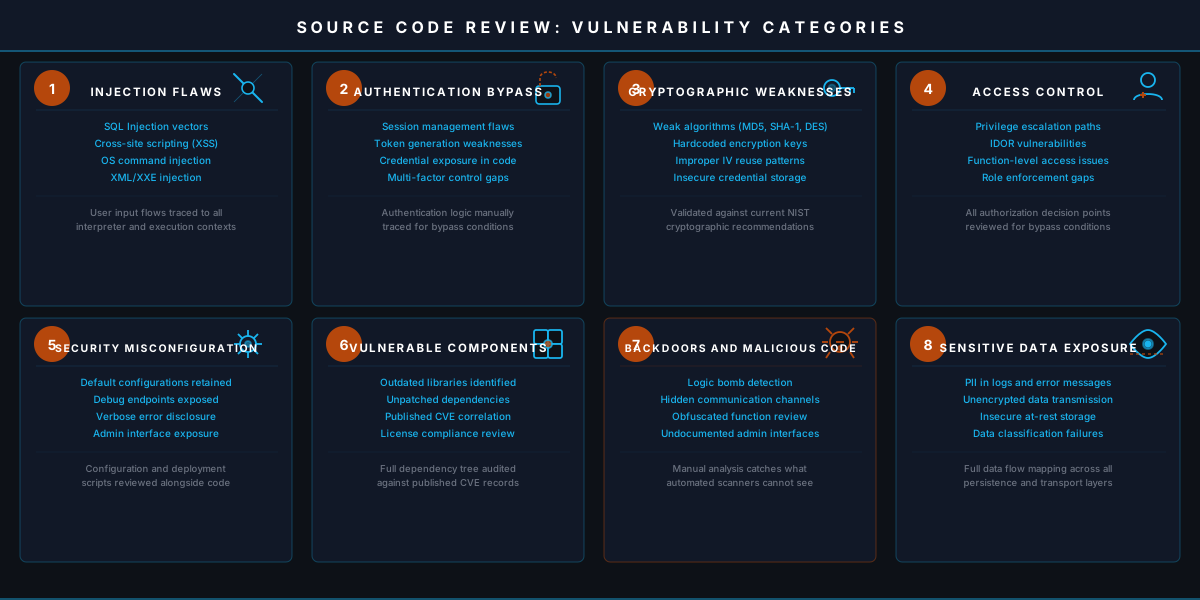
What a Source Code Review Actually Finds
The two use cases produce different deliverables. Security review is aimed at defects to fix before they cost the client an incident. Litigation analysis is aimed at questions of provenance and causation that decide a case.
Security review deliverables
| Item | What It Delivers |
|---|---|
| Exploitable defects prioritized by consequence. | Every finding is manually verified and rated by the actual impact an attacker could achieve, not by scanner severity. |
| Insecure design patterns. | Architectural decisions that will produce future defects even after individual bugs are fixed, flagged with the design change that would address the root cause. |
| Dependency and supply-chain risk. | Known-vulnerable dependencies, dependencies with concerning maintainer or licensing profiles, and typosquatting exposure in the package manager configuration. |
| Secrets and credential exposure. | Hard-coded credentials, API keys checked into history, and misconfigured secrets management that puts credentials into build artifacts. |
| Remediation that survives code review. | Each finding comes with the specific fix, written to satisfy the client’s own code review standards, not just the security requirement. |
Litigation analysis deliverables
| Technique | What It Reveals |
|---|---|
| Structural and textual similarity findings. | Where two codebases share structural patterns, algorithmic choices, naming conventions or specific implementations at levels inconsistent with independent development, the analysis documents it with quantitative similarity metrics and side-by-side excerpts. |
| Commit and authorship timeline reconstruction. | When specific constructs appeared in each repository, who committed them, and what the commit history reveals about the sequence of development in each codebase. |
| Dependency-graph and build-artifact provenance. | Third-party libraries, framework choices and build outputs compared to identify shared origin points that would not survive independent development. |
| Causation analysis for defect claims. | Where a specific defect is alleged to have caused a claimed loss, the analysis documents whether the defect actually existed in the code at the relevant time, whether it was reachable under the conditions in play, and whether the outcome is consistent with the defect being the cause. |
| Reports structured for expert testimony. | Findings written to satisfy the transparency and reproducibility expectations of federal and state court expert evidence. |
How We Do Security Review
Manual audit anchored on threat modeling of the specific system under review, supported by tooling appropriate to the language and framework. Static analysis catches the finding classes it is good at; manual audit catches the ones it is not. Interactive and runtime testing where the environment supports it. Dependency and secrets scanning across the repository and its history.
Language coverage across Python, Go, Java, .NET (C# and F#), JavaScript and TypeScript, Rust, C and C++, Swift, Kotlin, PHP and Ruby. Smart contract review across Solidity (EVM), Rust (Solana), Move (Aptos and Sui) and Cairo (Starknet). Aviation and embedded systems in C, C++ and Ada.
Deliverables are structured so engineering can act on them: findings ranked by exploitability and consequence, remediation with code-level guidance, and re-audit of the corrected code included as a defined phase rather than an optional add-on.
How We Do Litigation Code Analysis
Litigation analysis is a forensic exercise rather than an engineering one. The methodology is scoped to the specific question the matter turns on, and the report is written to support the answer under cross-examination.
Structural analysis
Comparing the two codebases at the architectural level: module decomposition, control-flow patterns, class hierarchies and interface designs. Independently developed codebases addressing the same problem typically converge on similar high-level patterns; where they diverge is often more diagnostic than where they agree.
Textual and semantic similarity
Detailed comparison of specific implementations, comment style, naming conventions and idiomatic choices. Purpose-built comparison tools identify passages of interest; manual review determines whether the similarity is diagnostic of copying or of parallel development from common training sources.
Commit history and authorship
Analysis of the repository history in each codebase to establish the sequence in which specific features and constructs appeared, and to identify authorship patterns that survive across the histories. Where a departed engineer’s constructs appear in a competitor’s codebase in a sequence consistent with the timeline, the history documents it.
Dependency and build provenance
Third-party libraries, framework choices, build tooling and build outputs compared for shared-origin evidence. Bespoke internal utilities that appear in both codebases are particularly diagnostic.
Reporting structured for testimony
Findings are documented with the methodology applied, the limitations of each analytical technique, and the basis for each conclusion. We report what the evidence supports without arguing the ultimate legal conclusion, because that determination belongs with counsel and the trier of fact.
Where Our Miami Practice Runs Deepest
Fintech, crypto and digital-asset code
Payments platforms, money service business infrastructure, custody and exchange systems, and the smart contracts behind them. Pre-launch security audits, ongoing review programs and incident-triggered code analysis for the Miami digital-asset cluster.
Trade-secret and departing-founder litigation
Codebase comparison in trade-secret matters and post-employment disputes. Structural analysis, commit history reconstruction, and expert reporting structured for federal and state court proceedings.
M&A and investment due diligence
Independent code and security due diligence for acquisitions and significant investments in software companies. Findings framed around the specific deal risks that matter to the transaction, from license-compliance exposure to security posture and technical debt.
Aviation and connected-avionics software
Security review of software supporting airworthiness certification pathways, structured against the evidence expectations of FAA and EASA cybersecurity guidance so the review deliverable slots into the certification submission.
Healthcare and regulated-data platforms
Application security review for HIPAA-scoped systems and platforms handling personal information under Florida’s notification obligations, with findings mapped to the compliance frameworks the client already operates under.
Standards and Standing
Methodology follows OWASP ASVS, the OWASP Top 10, CWE Top 25, and NIST Secure Software Development Framework (SSDF). Smart-contract review follows the standards published by the major EVM security working groups and the applicable chain-specific guidance for non-EVM platforms. Reviewers hold GWEB, GSSP-Java, GSSP-.NET, OSWE and CISSP among other credentials. Reports for litigation matters are structured for authentication under Fla. Stat. § 90.901 and Federal Rules of Evidence 902(13) and 902(14), and expert testimony is delivered by the reviewer who performed the analysis.
Last updated: September 4, 2026
Review Before You Ship, or Before You File
Whether the code is going to production or into evidence, the value of the review depends on it happening early enough to matter. The first conversation is worth having before scope hardens.
Code Evidence Requires Expert Analysis
Security review before a defect ships. Litigation analysis when the codebase itself is at issue. Both come from the same team, using the same discipline, and produce the documentation the audience actually needs.