

Computer Forensics That Holds Up in Court
When a case turns on what someone did on a computer, we produce the record of it. Deleted files that come back. Documents with a version history the drafter did not know was there. Login trails, USB connection logs, browser history and file-access timelines that put a person at a keyboard on a specific date. We recover it, we document how we got it, and we testify to it in Miami-Dade, Broward, Palm Beach and the Southern District of Florida.
What a Computer Forensic Examination Actually Finds
A well-run examination answers questions in ways documents alone cannot:
Timelines of what happened, and when
Every file access, program launch, USB device connection, network login and system event is logged somewhere on a modern computer. We reconstruct the sequence so a lawyer can put a chronology in front of a judge that says: at 9:42 p.m. this account opened this document, at 9:47 it was attached to an email, at 9:51 the drive holding it was ejected. Timelines like that decide cases where a party claims they were not there or did not know.
Deleted content, brought back
Deleting a file rarely removes it. It flags the space as reusable, and until that space is overwritten the content is recoverable. The same is true for emails, chat messages, browser history and images. We recover deleted material, document what condition it was in when we found it, and preserve it in a form that can be produced without arguing over authenticity.
Document version history
A Word file, an Excel spreadsheet, a PDF or a Google Doc frequently retains prior drafts inside itself or in cloud metadata. We recover previous versions, identify who edited what and when, and surface changes the current version has been scrubbed of. That evidence is decisive in contract disputes, will contests and any matter where a party claims a document said something different at an earlier date.
Photo and video authentication
Every camera and phone stamps images with metadata: when the picture was taken, on what device, at what GPS coordinates and with what camera settings. Editing software leaves its own fingerprints. We can distinguish an original photograph from one that has been retouched, staged, backdated or extracted from a different source, and we testify to the basis for that distinction under Rule 901.
Who touched what
File-access logs, account-authentication records and USB-device connection history establish who was in a system and what they interacted with. In departing-employee and trade-secret matters, that record is usually the case: what the employee opened, when they connected an external drive, what got copied and where the copy went.
Messages, chats and email, including deleted ones
SMS, iMessage, WhatsApp, Signal, Teams, Slack and corporate email all live in databases that retain far more than what a user sees on screen. We reconstruct the full record, including read receipts, edits and messages a party thinks they erased.
How We Work
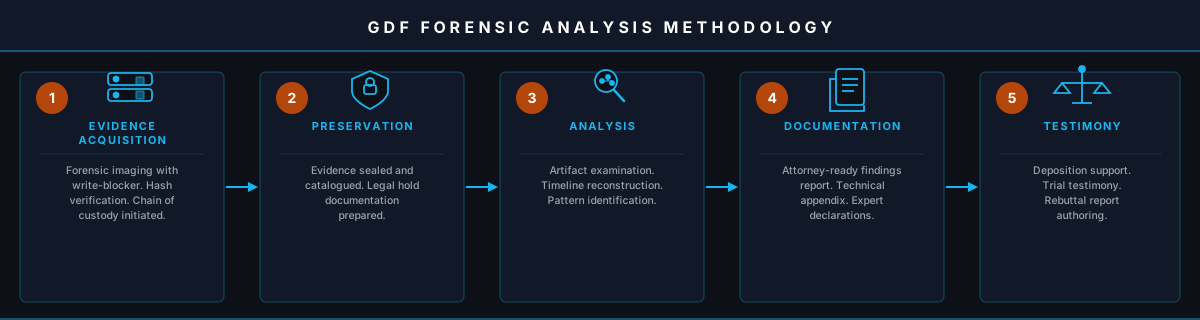
A computer forensic engagement runs in a defined sequence:
1. Acquisition
We image the device bit-for-bit rather than copying files. Every sector on the drive, including unallocated space where deleted content lives, is preserved. The original is sealed; all analysis runs on the copy. Every step is hashed so the integrity of the evidence can be proven at every point.
2. Analysis
The image is loaded into forensic tools (EnCase, Magnet AXIOM, X-Ways, Cellebrite depending on the source) and examined against the questions the matter turns on. We work from a written scope agreed with counsel so the examination stays focused and the findings are responsive to what the case actually needs.
3. Reporting
Findings are documented in plain language with the technical basis for each conclusion, the tools and versions used, the limitations of the analysis and the exhibits a party would introduce. The report is written to be read by a judge and cross-examined by opposing counsel.
4. Testimony
The examiner who performed the analysis is the examiner who testifies. Deposition preparation, direct examination, cross and rebuttal are handled by the person with first-hand knowledge of the evidence, not a witness reading from someone else’s notes.
Where Our Miami Practice Runs Deepest
Every jurisdiction has its case mix. Ours in South Florida runs heavily to:
Construction disputes
Project management systems, submittals, RFIs, change orders and site-photo timelines are the record of what a project actually did versus what a party now says it did. We recover altered daily logs, back-dated approvals and deleted RFI threads that decide construction-defect and delay claims.
Maritime and admiralty
Vessel management systems, bridge audio and voyage data recorders, GPS chartplotters and NMEA network logs establish where a vessel was, at what speed, on what course, and what the crew did in the moments before an incident. That evidence supports Jones Act, Limitation of Liability and yacht ownership matters.
Land use, zoning and permit disputes
Municipal records, application submissions, engineer email threads and the revision histories of site plans are examinable evidence. We recover what was actually submitted, when, and by whom, and what was quietly changed after the fact.
Contract disputes
Version histories on the operative documents, email threads between drafters, and the metadata trail of how a final version came to look the way it does are frequently determinative. We produce the version the parties actually agreed to versus the version now in the file.
Equestrian industry matters
The Wellington-centered equine market produces sale disputes, ownership fights, stallion syndicate disputes and prohibited-substance allegations that turn on messaging records, veterinary system data, competition management systems and the digital trail around a horse’s medical and competition history. We work regularly with counsel in this niche.
Who Calls Us
Corporate counsel, litigation partners at South Florida firms, insurance defense teams, criminal defense counsel, government agencies conducting regulatory reviews, and individuals in high-value family, probate and business disputes. We accept referral engagements from counsel outside the region for matters with a South Florida connection.
Standards and Standing
Our examiners hold certifications from EnCase, Cellebrite, SANS and the International Association of Computer Investigative Specialists. Every acquisition is validated against NIST Computer Forensic Tool Testing benchmarks. Reports are written to survive Daubert challenges and are structured for authentication under Fla. Stat. § 90.901 and Federal Rules of Evidence 902(13) and 902(14). Chain of custody is documented from the first touch to the final production and is defended by the examiner who created it.
Last updated: September 4, 2026
Talk to an Examiner About Your Matter
All consultations are strictly confidential. Tell us what the case turns on and we will tell you what a forensic examination can and cannot establish.
Computer Forensics for South Florida Matters
Maritime and Admiralty Digital Evidence
Litigation arising across PortMiami, Port Everglades and the Biscayne Bay yachting corridor often turns on forensic extraction of marine electronic data. Commercial cargo vessels, passenger cruise liners and private motor yachts log navigational, propulsion and operational data across proprietary embedded architectures that standard IT tools cannot parse. In Jones Act personal-injury claims, proving unseaworthiness or crew negligence typically turns on establishing precise speed, heading, sea state and helm commands at the moment of the incident. We extract and authenticate telemetry from Voyage Data Recorders (VDR and S-VDR), ECDIS, AIS units, bridge audio recorders and engine-room alarm monitoring systems.
For yacht ownership disputes, groundings and Limitation of Liability proceedings, we perform physical memory acquisitions from marine GPS chartplotters (Garmin, Raymarine, Simrad, Furuno), depth sounders, radar units and NMEA 0183/2000 loggers. That work captures waypoint history, track logs, velocity vectors, throttle percentages and rudder angle telemetry, including after power loss or seawater exposure, and we deliver timeline reconstructions and hash-verified exhibits ready for state and federal court.
Hurricane and Storm-Surge Evidence Recovery
South Florida’s coastal geography exposes corporate data centers, medical practices, law firms and condominium associations to storm surge and rainwater intrusion during major Atlantic hurricane events. Saltwater contact begins rapid electrochemical corrosion on printed circuit boards, degrading drive read/write heads and controller interfaces within hours. When backup systems fail or on-premises servers are submerged, ordinary commercial recovery attempts risk destroying evidentiary data permanently. Where counsel must establish business-interruption loss, reconstruct pre-storm accounting records or meet proof-of-loss obligations, the salvage has to be done to a forensic standard the first time.
Our Miami facility maintains Class 100 laminar-flow workstations, de-ionization baths, non-conductive solvent wash stations and vacuum drying chambers to arrest corrosion. For mechanical drives we perform head replacements and platter transfers inside a sterile enclosure to produce sector-by-sector images. For SSDs, RAID sets, smartphones and embedded flash we perform chip-off extraction, reading raw dumps through hardware programmer sockets, and reconstruct file systems with full hash verification.
Condominium, HOA and Real Estate Records
Condominium associations across Miami-Dade, Broward and Palm Beach now operate under Florida’s structural integrity reserve study and milestone inspection framework. When maintenance disputes, construction-defect claims or board fiduciary fights reach litigation, the evidence sits in building management systems, elevator diagnostic logs, environmental sensor data and years of board correspondence. Parties routinely allege that inspection records were altered, that repair estimates were selectively deleted, or that a third-party electronic voting platform was manipulated during a contested director election. We image and analyze those sources, carve database transaction logs for backdated entries, and produce findings that stand up in Florida’s complex business litigation and administrative arbitration forums.