

eDiscovery That Turns Terabytes Into a Defensible Production
When a matter generates more data than a review team can read, eDiscovery is what makes it manageable. We collect the right sources, process out the noise, host the review, and produce documents in the format opposing counsel agreed to, on the schedule the court imposed. Findings come out priced predictably and documented well enough to survive the challenge that follows every material production.
What eDiscovery Actually Delivers
A well-run eDiscovery matter produces a small number of concrete outputs that a litigation team can act on:
| Capability | What It Delivers |
|---|---|
| A focused review population. | The initial collection is usually many times larger than what actually needs to be looked at. Deduplication, email threading, near-duplicate grouping and targeted searching cut the population down to what is responsive, so counsel is reviewing dozens of thousands of documents rather than millions. |
| A defensible privilege log. | Every document identified as privileged is logged in the format the court and opposing counsel require, with the basis for the assertion documented at the item level. That log survives a challenge without a re-review. |
| The hot documents, surfaced early. | Analytics, targeted searching and reviewer flagging identify the documents that carry the matter, and route them to counsel while the rest of the review is still running. That head start on strategy is worth more than the full production itself. |
| A production that will not be sent back. | The set is delivered in the exact format agreed at the ESI conference, with the metadata fields specified, Bates and confidentiality endorsement applied and redactions properly bonded to the image so nothing survives in a searchable layer. |
| Cost predictability. | Flat-rate hosting and analytics pricing means the review team knows what the matter will cost before it starts, and can defend the fee to a client or a court without having to explain a per-gigabyte overrun. |
The Full Lifecycle
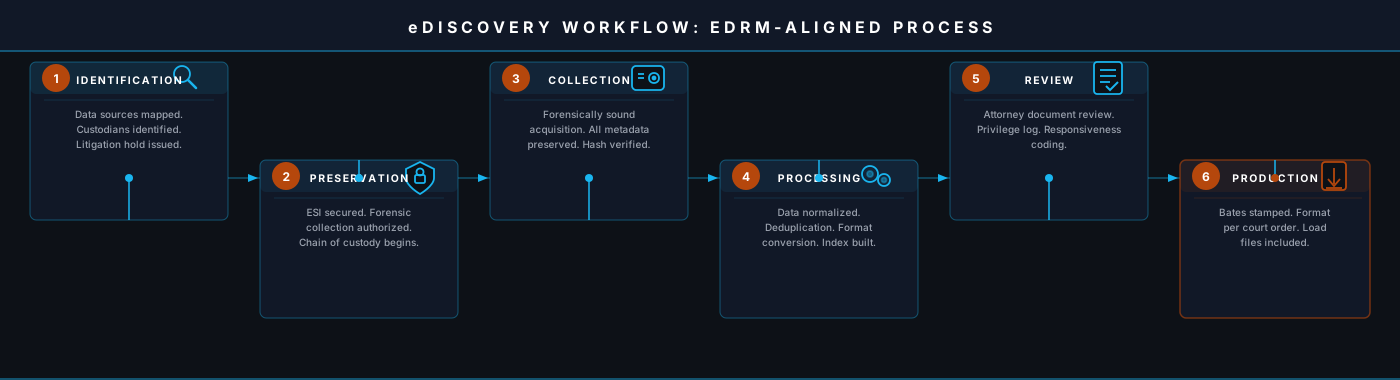
The Electronic Discovery Reference Model is the standard framework, and we run it as a defined sequence rather than a menu of à-la-carte services:
1. Identify
Before anything is collected, we scope. What custodians matter, what systems they use, what date range the matter covers, and what data lives outside the domestic environment. The output is a documented source map that anchors every downstream decision.
2. Preserve
Custodian hold notices, tracked acknowledgment and preservation-in-place configurations on the systems that support it (Microsoft 365, Google Workspace, Slack, Box). Where a source cannot be reliably preserved in place, we image it. The audit trail is the deliverable, not the notice itself.
3. Collect
Forensic acquisition from cloud tenants, on-premises servers, laptops, mobile devices and structured platforms. Every collection is documented with the method, the tool version, hash values, and the person who performed it, and every source is treated as if the acquisition record will be challenged, because eventually one will be.
4. Process
Deduplication (global or custodial per counsel’s election), family reconstruction, text extraction with diacritic preservation for Spanish and Portuguese populations, and load-file preparation for the review platform. Processing decisions are logged so the volume math at production is defensible.
5. Review
Hosted on Relativity or Reveal, with analytics, threading, near-duplicate identification and active learning available from day one. Bilingual reviewers where the population requires it. Documented QC with sampling-based error rates, not eyeballing.
6. Produce
To the specification actually agreed at the ESI conference. Image plus load file, native production for spreadsheets and structured files, text extraction and the metadata field set fixed in writing before the first volume goes out. Foreign business records are prepared with authenticating declarations at production, not scrambled for at trial.
Where Miami eDiscovery Practice Runs Different
Cross-border matters with Latin American reach
A meaningful share of South Florida corporate litigation reaches into Colombia, Brazil, Mexico, Venezuela and the Dominican Republic. Discovery in those matters is a data-transfer problem before it is a review problem, and it is decided by whether the source map, the scoping and the processing location are set up with the applicable foreign regime in mind.
Bilingual review populations
Spanish and Brazilian Portuguese content is routine, not exceptional. We staff review from the Miami legal market where bilingual attorney reviewers are available in depth, and we run diacritic-normalized search and language-aware analytics so the non-English portion of the population is treated with the same rigor as the English side.
Hospitality, cruise and marine industry matters
Property management systems, reservation platforms, shipboard messaging and shoreside operations produce data across systems that were never designed to be discoverable. We collect what actually exists in each system and reconcile it into a coherent production.
Construction and engineering disputes
Project management platforms, submittals, RFIs, daily logs, change orders and site photos are the record of what happened on a project. We collect them at the schema level so back-dated entries and deleted threads are visible in the production rather than hidden in a summary export.
High-net-worth estate and business matters
Complex probate, trust and closely held business disputes produce discovery across personal devices, private banking platforms, family office systems and international holdings. We handle the collection and processing under the confidentiality and privacy protections these matters require.
Platforms and Tooling
We host on Relativity and Reveal as the primary review platforms, with Nuix and Everlaw available where a matter or a firm standard requires it. Processing runs on Nuix and Reveal Processing. Structured-data extraction uses purpose-built tooling for property management, ERP and financial platforms. Cloud collections use vendor APIs directly (Microsoft Purview, Google Vault, Slack Enterprise Grid Discovery, Salesforce Data Loader) rather than screen-scraping. Mobile and endpoint acquisition is handled by our forensics team with Cellebrite, Magnet AXIOM and Oxygen Detective.
Standards and Standing
All work runs against EDRM as the process framework, Sedona Conference principles for defensibility and proportionality, and NIST SP 800-88 for media handling and sanitization. Our hosting environment is maintained against SOC 2 criteria; HIPAA business associate obligations are supported where a covered entity’s data is in scope; and foreign-custodian data is handled with awareness of the applicable regime (LGPD, Colombia’s data protection law, Mexico’s federal framework). Every production carries the authenticating documentation needed to satisfy the applicable evidence rules.
Last updated: September 4, 2026
Have a Matter Coming In?
Whether it is a routine subpoena or a multi-jurisdictional preservation order, the earlier the conversation the better the scope. Reach a discovery lead directly.
eDiscovery Sub-Services
Legal Holds and Preservation
Defensible custodian notification, preservation-in-place configuration and audit trail.
Data Discovery and Mapping
Source inventory across domestic and foreign systems before collection begins.
Cloud and SaaS Collections
API-based collections from Microsoft 365, Google Workspace, Slack, Salesforce and social platforms.
Mobile and Endpoint Collections
Forensic acquisition of phones, laptops and removable media with bilingual message handling.
Early Case Intelligence
Sampled analysis of the collected set before full processing to size and scope the matter.
Review Platform
Flat-rate Relativity or Reveal hosting with analytics and AI-assisted queues included.
Managed Review
Bilingual attorney review staffed from the Miami legal market with documented QC.
Production and Delivery
Productions to the specification actually agreed, with authenticating declarations for foreign records.
Structured Data Discovery
Schema-level extraction from ERPs, property management platforms and financial systems.
Security and Compliance
Role-based access, SOC 2 posture, HIPAA support and foreign privacy-regime alignment.
Solutions for Law Firms
Discovery partner for outside counsel from boutique to Am Law.
Solutions for Corporations
Repeatable workflows for corporate legal, compliance and legal ops teams.
Need eDiscovery Support?
Every discovery matter is time-sensitive. Preserve first, scope second, and get the production out on the schedule the court set. We handle the technical work so the litigation team can focus on the strategy.